ADHD Diagnosis and Treatment You Can Trust

A Thoughtful, Personal Approach
At Clearmind Health, we know that seeking an ADHD assessment can feel like a big step. Our role is to guide you through the process with clarity, compassion, and expertise — so you always know what’s happening and why.
How We Diagnose ADHD
How We Diagnose ADHD
ADHD is a complex condition with no single “perfect” test. That’s why all assessments at Clearmind are carried out by UK-registered doctors with specialist training in ADHD. Their skill and experience are essential in making an accurate diagnosis.
Your journey starts with a detailed conversation about your symptoms — not just today, but also how they’ve shown up throughout your life. Where possible, we’ll also gather insights from someone who’s known you since childhood, helping us build a complete picture of how ADHD may be affecting you across different settings, such as at home, work, or in education.
We use internationally recognised tools, such as the DIVA-5 (Diagnostic Interview for ADHD in Adults), to help identify ADHD symptoms and understand how they impact your daily life. By combining these results with our clinical expertise, we’re able to reach a confident, well-supported diagnosis
ADHD Treatment Options
How We Treat ADHD
At Clearmind, treatment is always personalised to you. For many people, medication plays an important role in managing ADHD symptoms and improving day-to-day functioning. Our focus is on helping reduce the core symptoms of ADHD — inattention, hyperactivity, and impulsivity — so you can feel more in control and able to live life to the fullest.
Stimulant medications (such as methylphenidate or amphetamine-based medicines) are usually the first choice, as they are highly effective for most people. They work by boosting certain brain chemicals, like dopamine and noradrenaline, to improve focus and reduce impulsive behaviour.
For those who cannot take stimulants or do not respond well to them, non-stimulant options such as atomoxetine or guanfacine are available. These work differently, often supporting brain pathways linked to attention and emotional regulation.
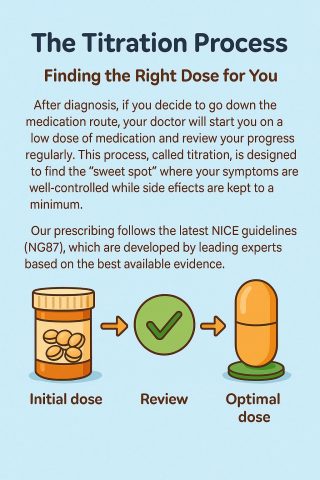
The Titration Process
Finding the Right Dose for You
After diagnosis, if you decide to go down medication route, your doctor will start you on a low dose of medication and review your progress regularly. This process, called titration, is designed to find the “sweet spot” where your symptoms are well-controlled while side effects are kept to a minimum.
Our prescribing follows the latest NICE guidelines (NG87), which are developed by leading experts based on the best available evidence.
Transitioning to NHS Care
Making the Transition to NHS Care
If you’re diagnosed and start treatment with Clearmind, you can choose to remain under our care or, if eligible, move your ADHD management to your NHS GP under a shared care agreement.
We provide your GP with a detailed medical report and treatment summary.
Your GP will then decide whether to take over prescribing.
If shared care isn't possible, you can continue with us for ongoing medication reviews every six months.

Your journey to clarity starts here

LINKS

CONTACT
Wellbeing Hub
6 Stephenson Court
Fraser Road
Priory Business Park
Bedford, MK44 3WJ
OFFICE HOURS
Mon – Fri: 9am-6pm
Sat: 8am – 2pm
Sun: closed